European Pellet Conference 2019
|
Date: Venue: |
26 - 28 February 2019 |

Programme "European Pellet Conference" (pdf)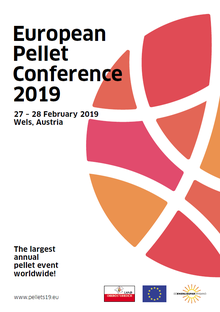
|
|
Conference fees: |
|
|
|
Conference languages: |
English, German |
|
|
Organisation and conference office: |
OÖ Energiesparverband |
|
|
With more than 450 participants each year, it is the
largest annual pellet event worldwide.
This meeting place for the global pellet community offers a great opportunity to get informed about current trends in the pellet and bioenergy world. In just 2.5 days, the event offers delegates:
Meet. Learn. See. Enjoy! |
||
PROGRAMME
Tuesday, 26 February 2019
08.30 - 19.00 Technical Site Visits: Pellets & wood chips
A full day of technical site visits about fuels, equipment and exemplary installations. Hands-on experience and information directly from technology suppliers and plant operators.
Wednesday, 27 February 2019
09.00 What‘s next for pellets?
With the Clean Energy Package, Europe is entering a new era in the energy transition: the new regulatory framework is changing Europe's energy markets. We show what this means for pellets and where we currently stand.
- Opening and welcome
Gerhard Dell, OÖ Energiesparverband, Austria
- The "Clean Energy Package": What‘s new for bioenergy?
Robert Kaukewitsch, European Commission, DG Energy - Pellets in Europe - market update
Gilles Gauthier, Bioenergy Europe / European Pellet Council - Sustainable bioenergy around the globe
Maria Michela Morese, United Nations (FAO) / Global Bioenergy Partnership - Other renewables and energy efficiency - friends or competitors of pellets?
Lukas Kranzl, Technische Universität Vienna, Austria
11.00 Leadership panel: Securing the role of pellets in the energy transition
Without biomass, the energy transition will not be possible! Decision-makers from along the pellet supply chain discuss how we can jointly strengthen the role of pellets in this global transformation process.
- Stefan Ortner
ÖkoFEN, Austria - Marco Palazzetti
Gruppo Palazzetti, Italy - Johan Granath
Ekman & Co, Sweden - Helmut Schellinger
Schellinger KG, Germany - Adam Sherman
Biomass Energy Resource Center, USA - Volker Lenz
DBFZ (German Biomass Research Centre), Germany - Gilles Gauthier
Bioenergy Europe/European Pellet Council - Christiane Egger
OÖ Energiesparverband, Austria
Chairperson:
Gordon Murray, Wood Pellet Association of Canada
Lunch break
14.30 Pellet Innovation Panorama
The energy transition offers many opportunities for new solutions, products and services – also in the pellet sector.
In this session, a variety of examples demonstrate the wide range of possibilities.
- Pellet innovations from Upper Austria applied worldwide
Werner Emhofer, Fröling, Austria
Gottfried Baumann-Leitner, Windhager, Austria
- A strategic approach to fibre supply
Shawn Bells, Operations for Pacific BioEnergy, Canada - Mobilising wood for bioenergy
Richard Sikkema, Wageningen University & Research Centre, The Netherlands - Pea starch as an additive in pellet production
Magnus Ståhl, Karlstad University, Sweden - Combined production of second generation ethanol and lignin pellets
Xavier Duret, Résolve Énergie, Canada - Wood pellet breakage during pneumatic delivery processes
Julian Jägers, Ruhr University Bochum, Germany - The new safety and storage standard
Hans Martin Behr, Deutsches Pelletinstitut, Germany - Microscale CHP with a fluidised bed stirling engine
Tanja Schneider, Friedrich-Alexander-Universität Erlangen-Nürnberg, Germany - Pellets from different raw materials
Tanmay Kotasthane, Trimurti Womens College of Science, India - Silometric - a sensor system for pellet silos
Alexandre Llusera Paredes, MC Systems, Spain - Mobile pellet heating systems
Ivo Bucher, Pellet-Mobil, Switzerland - A "pellet torch"
Tobias Mücke, Mücke Ambiente, Germany - Bioflex: combustion of challenging biomass fuels
Ingwald Obernberger, BIOS Bioenergiesysteme, Austria - Refawood: Reducing ash-related operational problems during combustion
Susanne Paulrud, RISE Research Institute of Sweden
19.00 Evening programme
Thursday, 28 February 2019
09.30 Session: What‘s new on European and global pellet markets
09.30 Session: Solutions for the combustion of challenging biomass fuels
09.30 Session: Reducing ash-related problems during combustion
09.30 What‘s new on European and global pellet markets
- Opening
Gordon Murray, on behalf of the European Pellet Council - Baltic countries: update from the North
Didzis Palejs, Latvian Biomass Association / Bioenergy Europe - Canada: "Vision Biomasse Québec"
John W. Arsenault, Quebec Wood Export Bureau / Wood Pellet Association of Canada - UK: insights into the future pellet market
Neil Harrison, reheat/Wood Heat Association, UK - Spain: increasing opportunities
Pablo Rodero, AVEBIOM, Spain - China: pellet production and consumption
Dou Kejun, China National Renewable Energy Center - Germany: consumer satisfaction from 20 years of pellet use
Martin Bentele, DEPV, Germany - Switzerland: new pellet projects
Martina Caminada, proPellets.ch, Switzerland - Sweden: competitiveness of pellets
Gustav Melin, SVEBIO - Austria: update on the pellet market
Christian Rakos, proPellets Austria - Italy: the world‘s largest residential pellet user
Matteo Favero, AIEL, Italy - Turkey: a market for pellets?
Tanay Sidki Uyar, World Bioenergy Association, Turkey
Chairperson:
Gordon Murray, Wood Pellet Association of Canada
12.30 End of the session
09.30 Solutions for the combustion of challenging biomass fuels
- Introduction to the ERA-NET project "BIOFLEX"
Ingwald Obernberger, BIOS Bioenergiesysteme,Austria - Fuel design concepts to reduce ash relatedproblems and emissions – experiences from singlepellet combustion tests
Christoffer Boman, Umeå University, Sweden - Combustion tests with kaolin additivated fuels inresidential boilers
Robert Mack, Technology and Support Centre (TFZ),Germany - Modeling fixed-bed pellet combustion of fuels ofvarying ash contents
Henrik Ström, Chalmers University of Technology,Sweden - Use of non-wood pellets in adapted small-scale boilers
Thomas Brunner, BIOS Bioenergiesysteme, Austria - Burner design for difficult pulverised biomass fuels
Pawel Bocian, Institute of Power Engineering, Poland - Guidelines for fuel design
Christoffer Boman, Umeå University, Sweden - Guidelines for advanced furnace/boiler design
Thomas Brunner, BIOS Bioenergiesysteme, Austria - Discussion, conclusions and outlook
Ingwald Obernberger, BIOS Bioenergiesysteme,Austria
This session is organised as part of the ERA-NETBioenergy project "BIOFLEX" in cooperation with BIOS: www.bioflex-eranet.eu
12.30 End of the session
09.30 Reducing ash-related problems during combustion
- REFAWOOD project overview
Susanne Paulrud, RISE Research Institute of Sweden - Elemental approaches to additives: mechanisms and dosage
Anna Strandberg, Umeå University, Sweden - Impact of additives in small-scale combustion of pelletised low quality wood
Thomas Zeng, Deutsches Biomasseforschungszentrum (DBFZ), Germany - Reducing downtime with additives in large-scale biomass combustion
Peter Sommersacher, BIOENERGY 2020+, Austria - The effect of additives on boiler corrosion
Martin de Jong, Dekra Solutions, The Netherlands - Forest residues and additives in a medium scale CHP-plant – legal framework
Magdalena Sajdak/Wojciech Cichy, Wood Technology Institute, Poland - Waste wood combustion: environmental consequences of using low-cost additives
Blanca Corona, Utrecht University, The Netherlands - Economic consequences of low cost additives
Alwin Hoogendoorn, Avans University of Applied Sciences, The Netherlands
Chairperson:
Sara Janhäll, RISE Research Institute of Sweden
This session is organised as part of the ERA-NET Bioenergy project "REFAWOOD": www.refawood.com
12.30 End of the session